Bring live U.S. communication into the school day.Keep your Teacher, curriculum and school identity at the center.
Learn & Work Florida gives schools a structured way to connect learners with qualified U.S. Teachers, trained adult Buddies and the Shining Speech™ framework. The purpose is clear: turn English from something students know into something they can use with people, while the local Teacher, timetable and school culture remain central.
Short enough for focus. Structured enough for progress.
The same five-part rhythm moves learners from curiosity into live speaking, explanation and a clear final output.
Built for the school day, not around a theory of the school day.
The system grows from day-to-day school practice and a modern curriculum prepared for live international communication. CEFR provides an international language reference, while CPALMS standards resources inform age-appropriate academic and ELA-related communication design.
The curriculum is prepared specifically for live international communication, from early speaking confidence through academic, research and leadership communication.
CEFR is used as an international reference point for language development and communication expectations.
CPALMS standards resources inform age-appropriate academic language, literacy and communication design.
Built around schools. Connected to families, educators and institutions.
The school is the natural center of the model: students learn, Teachers lead, international partners add perspective, and families stay connected to the child’s development.
Schools & Partners
Add structured U.S. communication to the school day while your own Teacher, timetable and educational identity stay central.
Explore the Partner model → 02Institutions
Develop pilots, school networks, exchange pathways, training hubs and longer-term educational cooperation.
Explore institutional cooperation → 03Families
For children who understand more English than they comfortably use and need purposeful live speaking practice.
Explore the child journey → 04Teachers & Buddies
Teach, supervise, mentor or build supervised experience inside a defined educational framework.
See the pathway →The language barrier is often wider than grammar or vocabulary. A learner may hesitate because the room feels fast, the answer might be imperfect, or there has simply not been enough practice speaking with another person. Shining Speech™ is designed to move that knowledge into participation.
Shining Speech™ creates repeated, structured reasons to answer, explain, ask, respond and present. The goal is not to add another worksheet. It is to give students a reason to use the English they are already learning.
A classroom method built around participation.
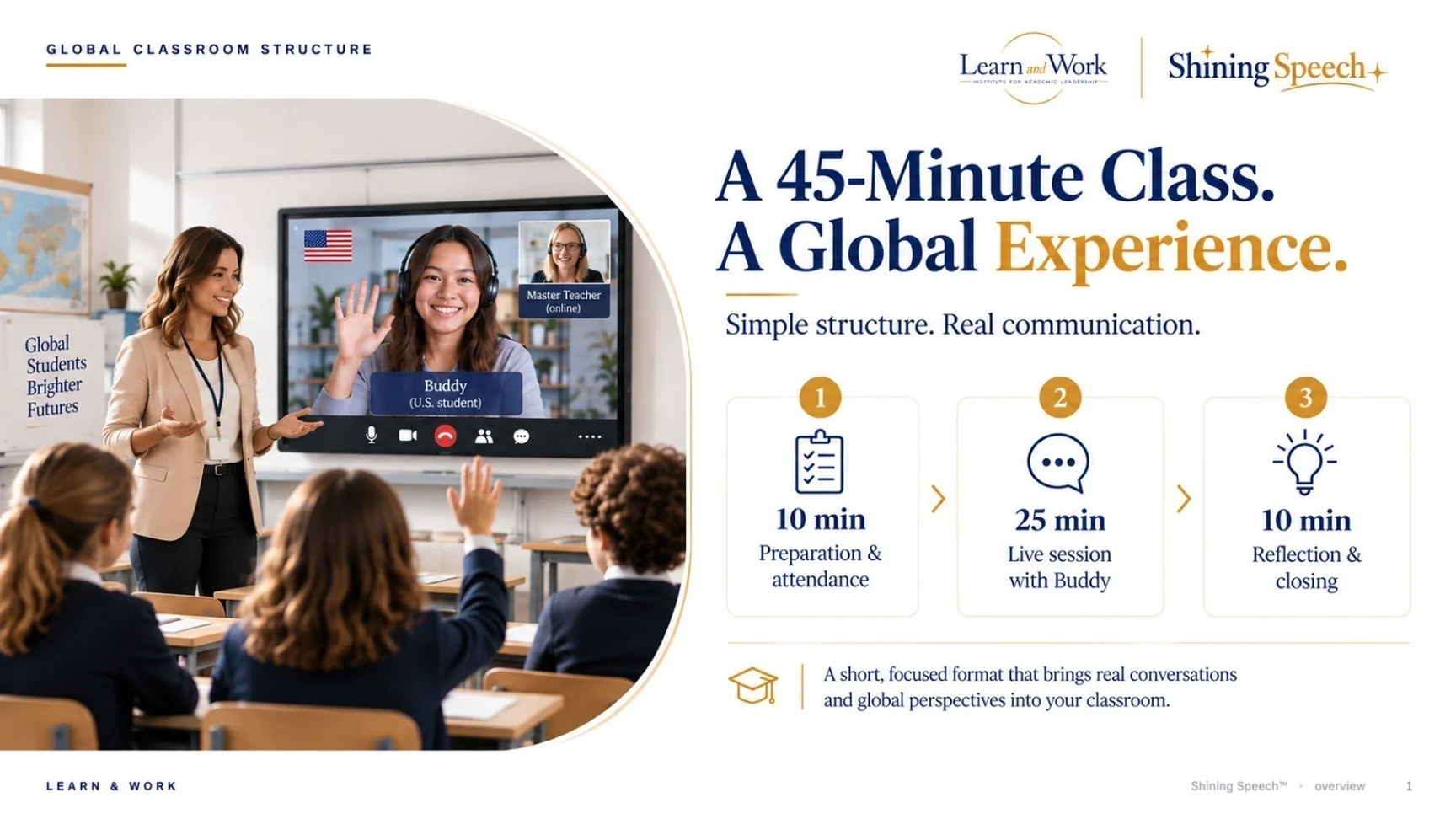
Each session follows a clear speaking rhythm. Students know what comes next, Teachers retain control of pace and challenge, and the lesson keeps moving from idea to interaction.
Hook
Create curiosity and a reason to speak.
Think
Give the student time to form an idea.
Turn & Talk
Move the idea into a live exchange.
Explain
Add a reason, example, story or point of view.
Present
Build presence, clarity and confidence.
For little learners, a smile can unlock the first sentence.
With younger children, the Buddy helps create a light, lively speaking atmosphere. A funny sound, a mixed-up word or an imperfect first try can become a moment to smile, correct it and keep going. That matters because speaking should feel social, curious and worth repeating. We want the child to leave thinking about the next conversation, not the last mistake. From around age 8, lessons become more structured and academically focused, while good humor remains part of the classroom culture and helps keep speaking natural.
The tone matures. The expectation to speak grows with it.
Younger learners begin through play, curiosity and short speaking turns. Older students move toward explanation, discussion, presentation and academic communication.
Sparkle Lab
Play, movement, listening, short speaking turns, curiosity and a safe first voice.
Wonder Squad
Sentences, stories, reading, explanation and first presentation habits.
The Think Tank
Opinions, reasons, collaboration, discussion and learning to defend an idea.
Global Spotlight
Academic discussion, media, leadership, public speaking and international communication.
What a family pays
Two sessions a week, or two trial lessons to begin.
Current public pricing can change. The registration page and applicable terms govern the final purchase.
The school lesson is intentionally compact. The individual lesson gives one learner more room.
The 25-minute session is the shortened school format: focused, repeatable and designed to fit real timetables. Families who want a longer 1:1 session can choose a 45-minute individual experience through Florida Star Academy.
School format
Compact live communication built for classrooms, partner schools and repeated speaking practice inside the school day, and for children 4–7 years old.
For SchoolsFlorida Star Academy · Individual
More time for one-to-one conversation, feedback, repetition, extension and individual pacing. Individual sessions for children 8+ years old.
Explore 45-Minute Sessions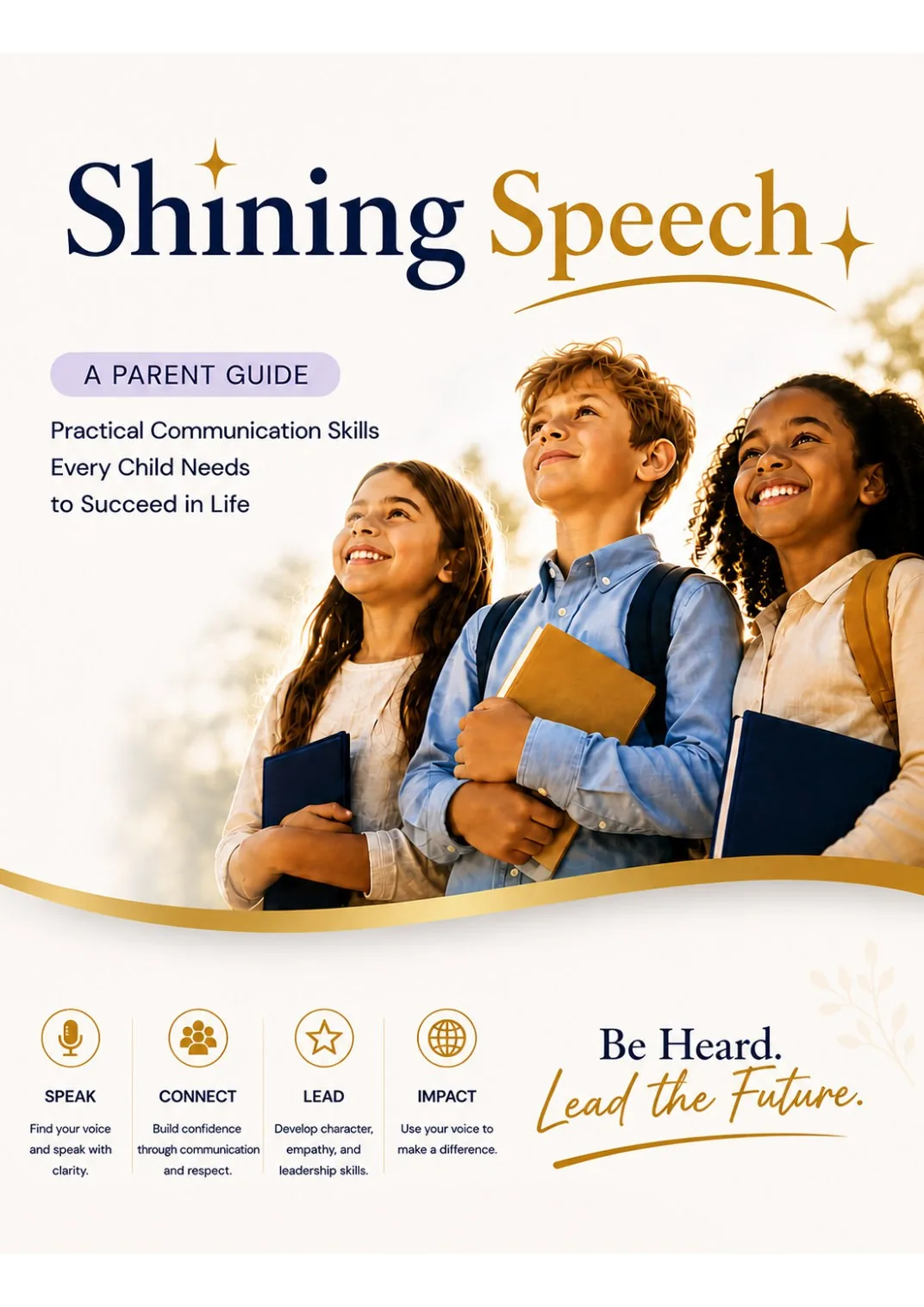
Claim your free Parent Guide
Shining Speech™ — practical communication skills every child needs to thrive. We will email you the PDF straight away.
Teacher protects the quality. Buddy expands the conversation.
The Teacher remains the educational authority: observing, guiding, evaluating progress and deciding when a Buddy is useful. The Buddy is an adult 18+ communication partner who works inside the prepared lesson framework and under defined supervision.
Speech confidence is considered separately from CEFR-aligned language ability. Group changes are based on Teacher judgment and, where relevant, parent agreement rather than an automatic score.
Add international communication without replacing what already works.
Learn & Work is designed as an additional communication layer around the school’s existing curriculum. The local Teacher remains central while students gain structured speaking practice, direct contact with U.S. educators and young adults, and a clearer view of education beyond their own classroom.
English moves into use
Students receive structured opportunities to answer, explain, question, respond and present in live English.
Stays central
The school Teacher remains part of the classroom experience while U.S. communication adds another layer of interaction.
Schools explain schools
Students can hear directly from U.S. Teachers and young adults about classroom culture, higher education, communication and everyday academic expectations.
Preparation extends beyond language
International dialogue can support higher-education readiness, presentation skills, cross-cultural communication and awareness of future study and work environments.
Let schools explain education to each other.
Partner Schools can connect their Teachers and students with international learners preparing for higher education, global mobility and future work. We value the school’s own voice because no brochure can explain U.S. education as clearly as the Teachers and students who experience it every day. Their classroom culture, expectations, student life and academic pathways become part of the exchange itself.
Class ↔ Class
Structured communication between learners around shared topics, questions and projects.
Teacher ↔ Teacher
Professional dialogue around classroom practice, communication and student preparation.
School ↔ School
Longer-term partnerships that can grow from conversation into pilots, projects and institutional cooperation.
Certified Teachers and homeschooling parents are welcome.
A short introduction to the mentor role and how experienced educators join the international classroom.
Nothing is requested from YouTube until you press play.
One develops the infrastructure. One brings it to the learner.
Research, curriculum, partnerships and educational infrastructure.
Program development, Teacher/Buddy framework, institutional cooperation, publications, supervision design and international network development.
Explore the Institute →The learning environment where the network meets.
Families, students, Teachers, Buddies and Partner Schools connect through the day-to-day Shining Speech™ experience.
Visit Florida Star Academy →We are looking beyond the English department.
Learn & Work welcomes licensed educators from art, mathematics, STEM, literacy, elementary education, PE, performance and other disciplines into Master Teacher pathways. We are also inviting applications for a remote Business Development Manager to help develop school, college and institutional partnerships.
Licensed Educators
Native-level English communication, an applicable teaching / educator license and a willingness to mentor, supervise and work inside one quality framework.
See Master Teacher Careers →Business Development · Remote
Help build institutional relationships across schools, colleges, universities and education organizations.
See Current Recruitment →Send your application.
Attach a CV and tell us which role fits you. Licensed educators from any subject are welcome, alongside remote business development.
Bring the conversation into your school.
Schools can begin with the Partner model, institutions can explore a pilot or exchange framework, and families and educators can enter through their dedicated pathways.